What is an Alpha Babe? ...outstanding human beings who exemplify the higher qualities of integrity, daring, innovation, honour, interconnectedness, caring, loyalty, and vision... who just happen to be housed in a female body...
Read more...
|
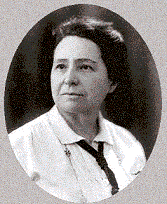
Alexandra David- Néel (1868-1969) was an exceedingly courageous, adventurous woman who blazed trails both physically and symbolically throughout her century-long life. In fact, she was the first Anglo woman to reach Lhasa in Tibet, and inspired the progenitors of the Beat generation.
She was born and raised by a Calvinist father and Catholic mother in France at the end of the 19th Century, and is said to have started running away from home nearly from the time she could walk. The young Alexandra could sense adventure beyond the horizon, and longed to experience her share of it.
“I cried bitter tears more than once, having the profound feeling that life was going by, that the days of my youth were going by, empty, without interest, without joy. I understood that I was wasting time that would never return, that I was losing hours that could have been beautiful. My parents – like most doting parents who have raised, if not a large eagle, at least a diminutive eaglet obsessed with flying through the air – could not comprehend this in the least and, although no worse than others, they did me more harm than a relentless enemy.”
Her long life was entirely devoted to exploration and study, the two overriding passions that made her unruly in her childhood, rebellious in her adolescence, anarchist in her youth, and one of the wisest ‘free thinkers’ of the 20th century in her old age1 In her early adulthood she traveled as much as she could around Europe, studying Theosophy, Sanskrit, Buddhism, the Koran, and joined a variety of secret societies; including that of the Freemasons, in which she reached the thirtieth degree. But she still felt wanderlust in her bones, and a longing for wild open spaces. It’s said that when traveling she invariably picked the longest itinerary and the slowest means of transportation.
She did marry a man, Philip Néel, a railway engineer in Tunis, and tried to devote herself to married life. But after a very few short years it was clear that domesticity was not in her nature, and he agreed to support her financially in a venture across the continent to India. Nonetheless the two remained very dear friends for the remainder of their lives, such that she wrote in a letter to him, “I believe you are the only person in the world for whom I have a feeling of attachment but I am not made for married life.”
While she traveled throughout India and China, she learned the Tibetan language in a variety of Buddhist monasteries, and persuaded herself that she needed to experience Tibet itself in spite of the prohibition set by the British Empire against access by foreigners to the holy city, vowing to “reach Lhasa and show what the will of a woman could achieve.”2 The Fourteenth Dalai Lama wrote in his foreword to her book, My Journey to Lhasa, “Not only were independent woman travelers like her unusual, but Europeans versed in Sanskrit and Buddhist philosophy, who also spoke Tibetan and could communicate with those they met, were extremely rare.”
Her life is a fascinating one, and fortunately is recounted in her over thirty (30!!) books on the subject, which she wrote in her retirement in a French chateau. As a woman who followed her own instincts and desires rather than kowtowing to anyone else’s expectations, and who applied her physical, mental and emotional bodies to support that of her spiritual, Mme. David-Néel definitely deserves her position among the pantheon of Alpha Babes.
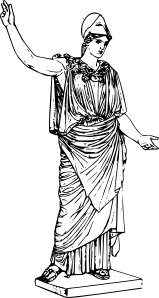
Pallas Athena is the Greek goddess of War, Wisdom, and Civilization.
What an interesting combination, yes? She is an iconic Alpha Babe because she is always on call, always alert, every read for action, has enormous self-respect without being arrogant, and brings wisdom and courage to any situation.
Athena was born fully grown and fully armed from her dad’s head. King god Zeus had a headache (no wonder!), so he knocked himself on the noggin and out came his daughter. An immaculate conception and birth if there ever was one. Her birth from the head is quite different from her half-brother Dionysus, who was born from his father’s side. The symbolism is obvious – from the mind of the divine comes Wisdom.
Because she was fully armed she’s a goddess of the higher concepts of war, as opposed to another half-brother Ares, the god of actual bloody, bruising combat. Except for some personal involvement in that famous misunderstanding between the Trojans and the Greeks, Athena’s approach to war is strategic, seeing the big picture, moving around heroes and armies, dealing with conflicts on a national and idealistic level.
Her own symbols are an owl for wisdom, an olive branch (she created the olive), and a lightning bolt. She was allowed to carry Zeus’s shield and his lightning bolt, which was quite an honor. For us it means an Alpha Babe carries the power of the higher entity, be it a government, an organization, an ideal, or one’s own higher nature.
Besides creating the olive – and where would cuisine be without olive oil – she also created the bridle for taming horses, in particular the winged steed Pegasus. Our lesson is that rationality can control passion – not to stifle it, but to use it to fly; wisely, but with joy.
The Greek and Roman pantheon had many human characteristics and Athena is no exception. She was one of three goddesses in a rigged beauty contest. She tried to bribe the judge Paris by offering him victory in battle but he chose the beautiful babe offered by Aphrodite instead. Paris got the lovely Helen, took her to Troy, and you know the rest.
One of Pallas Athena’s gifts to a mortal gives us a good lesson. When the hero Perseus set off to slay the gorgon Medusa, Athena gave him her own highly polished shield to use as a mirror to deflect Medusa’s deadly gaze, which could turn men to stone. Sometimes the best way to deal with a problem that has defeated others (or ourselves again and again) is to come at it from a different angle.
Perhaps Athena’s most relevant symbolism for us is her helmet, pushed back off her forehead. The eyes of her helmet are above her actual eyes. This symbol of double-vision can inspire us to have higher vision as well as our real-world vision. It can instruct us to look at everything from at least two different perspectives. It can remind us that our own nature is a duality – passion and ration, the outer life and the inner life, intellect and intuition, our human nature and our divine nature.
Athens was Athena’s special city and the famed Parthenon is her temple there. Homer called her “grey-eyed” and the Romans called her Minerva.
Pallas Athena’s characteristics are wisdom, reason and purity – not a bad example for any of us.
|